Neuroscience for AI inference
Biology-guided
LLM steering.
We are developing manifold-native steering algorithms from human neural imaging data to lower inference costs.
Our bet: the principles brains use to conserve energy can help AI use fewer tokens.
Research in progress
Built for models you control
Evolution had
an energy budget.
Evolution shapes biological neural architecture under metabolic constraints. Brains must produce useful behavior with limited energy.
We believe those constraints reveal principles for minimizing AI token use. Our work connects neural geometry and biological perturbations to the behavior of artificial networks.
The question we are testing is whether these principles can reduce inference costs while preserving performance.
Research on the metabolic cost of neural informationNeural geometry.
Measurable behavior.
Linear steering can drive off-target behavior when it ignores the geometry of a model’s internal representations. We are developing control methods that respect that geometry.
Map biological representations
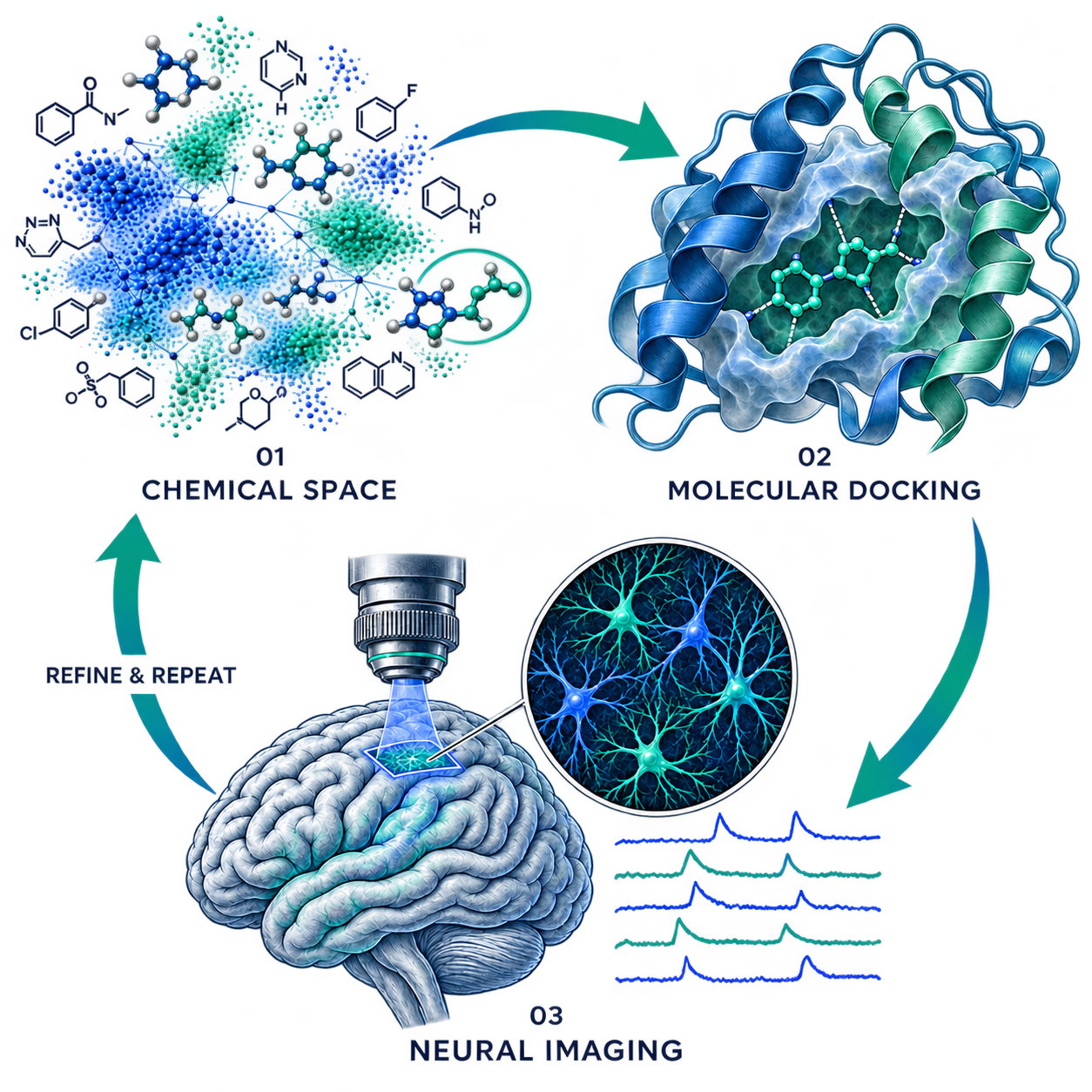
Use human neural imaging to characterize the structure of neural activity and its relationship to behavior.
Identify control principles
Combine neural data with targeted biological perturbations to investigate how networks change behavior under energy constraints.
Test the transfer to LLMs
Develop manifold-native interventions during inference. Compare task performance, off-target effects, and net compute cost against existing methods.
We earn a share
of what we save.
We’re looking for AI teams running high-volume inference on models they control. We’ll benchmark against your existing optimization stack on your workloads, while maintaining output quality.
Talk about your workloadof verified net compute savings.
You keep 90%.
Our proposed pricing includes the cost of running the steering algorithm in the savings calculation. If we don’t save you money, you don’t pay.

Dr. James
Newton Brandt
Rockefeller University
Johns Hopkins
I’m a neuroscientist with a PhD from Rockefeller University and research experience at Johns Hopkins. My work spans computational neuroscience, molecular pharmacology, and structural biology. I study how biological perturbations change neural activity and behavior.
A closer look.
What is manifold steering?
A manifold describes the structured set of internal states a neural network uses. Manifold steering changes the network’s activity along that structure to influence its behavior. In an LLM, those changes can happen while the model generates an answer.
Who is this for?
Teams operating open models or their own model-serving infrastructure. Our approach needs access to internal model activations, so a text-only API endpoint is not enough on its own.
How will savings be measured?
We’ll compare the total compute cost of completing the same tasks with your existing stack and with Ex Silico. That includes steering overhead, retries, and agreed quality and latency requirements. Fewer tokens only count if they produce real savings.
Where are you in development?
We are developing the research prototype and expanding our neural-data library. Our next steps are to test more complex associations and establish customer trials. We are seeking prospective pilot partners.
Let’s test it on
your workload.
james@exsilico.bio